Naveen Wijesinghe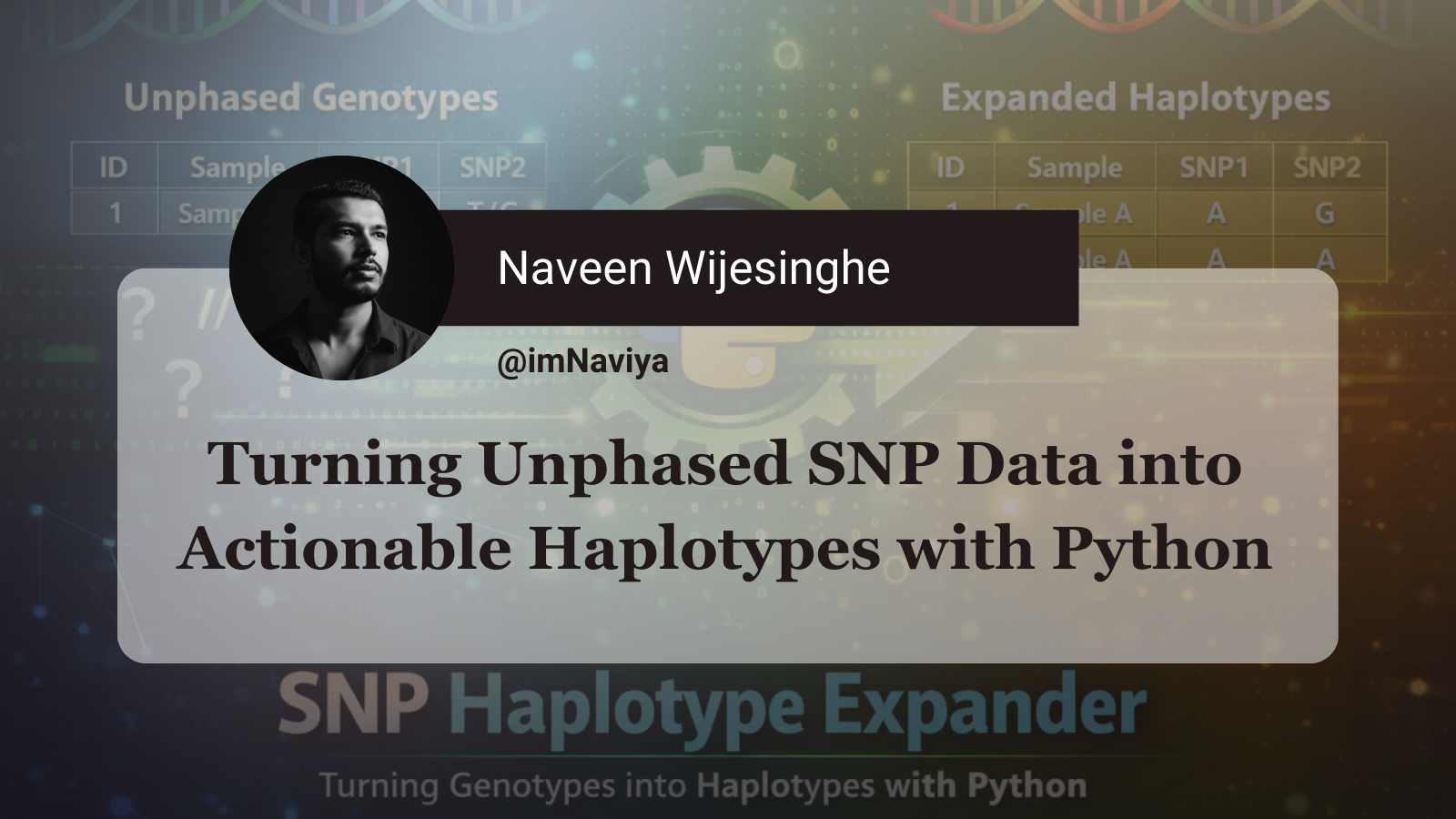
In genomics and population genetics, raw SNP genomic data is ubiquitous. But one common challenge remains: many genomic datasets are undifferentiated. When alleles are reported as combinations such as A/T or G/C, we don’t know which alleles belong to the same chromosome, limiting deep genetic analysis.
While working with large-scale genomic datasets, I ran into this exact problem. The solution led me to build SNP Haplotype Expander—a lightweight Python tool designed to efficiently expand undifferentiated SNP genomic data into all possible haplotypes.
Why Unphased Genotype Data Is a Problem
Unphased SNP data hides important biological context. Without haplotypes:
- Inheritance patterns are unclear
- Population structure is harder to interpret
- Downstream analyses (association studies, linkage analysis) lose accuracy
Phasing algorithms exist, but in many workflows you first need all possible haplotype combinations before applying statistical or ML-based models.
That’s the gap this tool fills.
What SNP Haplotype Expander Does
SNP Haplotype Expander takes genotype data like:
T/C, G/Aand expands it into every valid haplotype combination — without altering the original dataset structure.
Key capabilities:
- Expands heterozygous SNPs into all possible haplotypes
- Preserves CSV headers and formatting
- Processes data row-by-row for memory efficiency
- Designed to work smoothly with large genomic datasets
- Pure Python, no heavy dependencies
How It Works (Conceptually)
Each heterozygous SNP is treated as a binary choice.
For every row:
- Homozygous SNPs remain unchanged
- Heterozygous SNPs generate multiple allele combinations
- All combinations are expanded using a Cartesian product
- Each haplotype is written as a separate row
If a row contains n heterozygous SNPs, it produces 2ⁿ possible haplotypes — making the tool powerful yet transparent in its behavior.
Why This Matters
Haplotypes offer far more insight than isolated SNPs. By expanding unphased data:
- Researchers gain better visibility into allele combinations
- Data becomes ready for advanced analytics, ML, and statistical modeling
- Genomic pipelines become more flexible and reproducible
This tool works especially well as a preprocessing step in larger bioinformatics workflows.
Built with Simplicity & Performance in Mind
Instead of loading entire datasets into memory, SNP Haplotype Expander processes one row at a time. This streaming approach keeps memory usage low and makes the tool suitable for real-world genomic datasets — not just small experiments.
Looking Ahead
This project is part of my ongoing interest in:
- Computational biology
- Data engineering for scientific research
- Python-based tools that bridge raw data and intelligent analysis
There’s plenty of room for extension — from probabilistic phasing to ML-assisted haplotype ranking — and I’m excited to explore where this can go next.
Project Repository:
https://github.com/naveen-98/snp-haplotype-expander
If you work with genomic data, bioinformatics pipelines, or data-heavy research workflows, I’d love to hear your thoughts or ideas for improvement.